
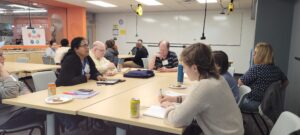
 Our tenth season of Collab Labs kicked off last week with a session co-hosted with Adriana Vázquez, Director of Education & Public Programs, and Maisie Buntin, Outreach Programs Coordinator for the Milwaukee Public Museum. Every year, the Milwaukee Public Museum hosts its annual BioBlitz, a 24-hour event where scientists survey the biodiversity in a park or natural area. Our session focused on a nagging issue for Adriana and Maisie– BioBlitzes don’t happen during the school year, so the museum misses opportunities to engage school audiences.
The Museum is working to adapt this big event into smaller, student-driven “mini-BioBlitzes” to be held at schoolyards, community organizations, and more. The Collab Lab provided an opportunity to explore that idea with educators and potential collaborators.
Discussion
Our conversation covered how attendees currently engage with students or community on biodiversity or other environmental topics, and what is missing from that engagement, how MPM mini BioBlitzes might play a role in addressing those gaps, and what’s needed to make that work.
Over the course of the evening, several broad themes emerged.
The need to build hands-on, real-world learning into school culture
- Getting students excited and connected to the content can be a challenge:
- Students need to see illustrate real-word relevance to lessons
- When schools have even just one teacher or admin motivated to provide these hands-on, real-world experiences, students show more interest and excitement
- Giving students the opportunity to work on something real, present their work and ideas to an authentic audience are key motivators, environmental justice and civic engagement– focus on a local park or site, are useful entry points, particularly for those that aren’t (yet?) “Nature Nerds”
- How can we do better to “operationalize” this type of learning – turn it from one person’s project into school culture and expectations?
- Make it easy for teachers to take on the work:
- cover their time to participate in training
- provide funding and resources to implement effectively
- explicitly tie to standards
- engage community resources to support efforts within K-12
- empower older students to support the work of younger peers
- start with the easiest entry points for teachers and build out from there
- Scaffolding – build capabilities to participate across grade levels. As examples, for mini-BioBlitz, kindergarteners do a color walk, elementary might look at various stages of categorization (ex. # insects, # plants, # of birds, etc.), up to high school (working with dichotomous keys, doing biodiversity index, etc.)
- Biodiversity education is largely missing from afterschool/out of school programming. Teens Grow Greens offers a model for how that can be done.
- Make it easy for teachers to take on the work:
Data collection and interpretation is a possible unexplored avenue of BioBlitz engagement
- Using data from mini-BioBlitzes, at different locations, or from MPM full BioBlitz,
- Potential alignment with AP exam topics re: data collection and analysis
- Incorporation of GIS provides could provide additional entry points for exploration
- Tap expertise who may know of similar projects in other parts of the country
- Curate and interpret data as an asset within the school
Integrating technology into this work
- Identify apps/tools like iNaturalist that schools might leverage
- Opportunities for students to create digital tools
- As focal point for conversations around AI and how teachers are being asked to incorporate teaching about it – this could be an avenue to illustrate appropriate use of AI (ie. for species recognition)
Going beyond science
- Tie in the arts (conveniently, the theme for our March Collab Lab)
- Representation/social justice/environmental justice, e.g. how is biodiversity/access to biodiverse habitats correlated with socio-economic status?
- Connect to student identity and background
What’s Next
We’ll have a chance to explore these topics further in our December and April Collab Labs with The Society for Conservation Biology North America (SCBNA), whose 2026 conference will be in Milwaukee. SCBNA has some upcoming webinars exploring the value of scientific assessments to communities and policy makers. You can find the schedule and registration information here.
In November we will take on another project in the works, to explore how TRUE Skool‘s planning for a new campus might serve as through line to connect K-12 students to programming, expertise, and experiences over the course of that effort– from planning and design, through site acquisition and construction.
Thanks
A big thanks to Adriana and Maisie for working with us to pull the session together and facilitate the conversation. Thanks also the MSOE’s STEM Center our host for another season of Collab Labs.
Thanks also to Leah Rosenbaum from STEAM Milwaukee who was able to join us for the session. She notes that STEAM Milwaukee has a number of resources in their lending library for teachers who want to dive deeper into environmental explorations. These include sampling nets (not pictured on the website) as well as 8 microscopes and a set of Vernier probes. Leah also mentioned Dear Data, as offering examples of both the simple ways data can be shared (via hand drawn annotated diagrams on postcards) and the range of ways data might be presented to illuminate an area of focus.