
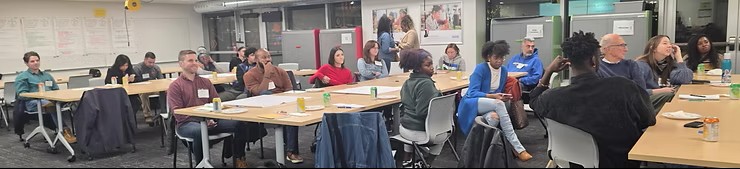
 Our November Collab Lab explored how TRUE Skool‘s work to to envision and develop a new campus for their programs could be leveraged as an opportunity to engage youth throughout the process and help them build the skills, and relationships useful to pursue careers in architecture, construction, real estate and related professions.
Some Background
The idea for the Collab Lab was the result of several threads coming together. TRUE Skool has been thinking about new space for their programs, that would get them out of lower level space within The Avenue. While TRUE Skool wants to remain downtown, a location broadly seen as accessible to all in an otherwise highly segregated city, it also wants greater visibility for their programming and the work their students do.
In 2023, Wisconsin Chapter of the National Organization of Minority Architects (Wisco NOMA) launched it’s first Project Pipeline Camp — a 3 day design workshop for middle and high school students interested in architecture. The work students did there focused on space planning for TRUE Skool. Wisco NOMA has run Project Pipelines Camps each summer since then, expanding to offer camps in Madison and Milwaukee for each of the last two years, always with the participation of a number of students from TRUE Skool.
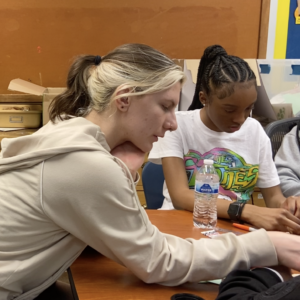
In parallel, TRUE Skool as continued working with its students to explore what a new campus might look like. This spring, with support from Community Design Solutions (CDS), TRUE Skool students participated in a design challenge to envision what spaces within a new campus might offer.
Conversations over the summer with Wisco NOMA and TRUE Skool highlighted how aligned goals could build to a much larger opportunity. Wisco NOMA has wanted to connect students participating in it’s camps to further opportunities during the school year. TRUE Skool wants to see students engaged as active participants in realizing it’s vision of a new campus. Those conversations led to the idea of Future Builders– putting together a network of individuals, organizations, and programs that engage youth in architecture, construction, real estate, and related professions, that could use TRUE Skool’s vision for a new campus as an opportunity for collaboration, that could offer students a connected series of opportunities over an extended period of time.
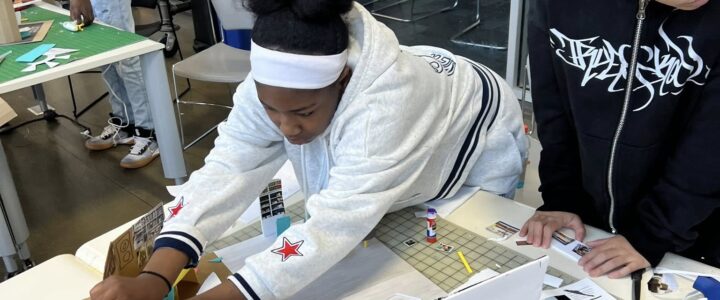
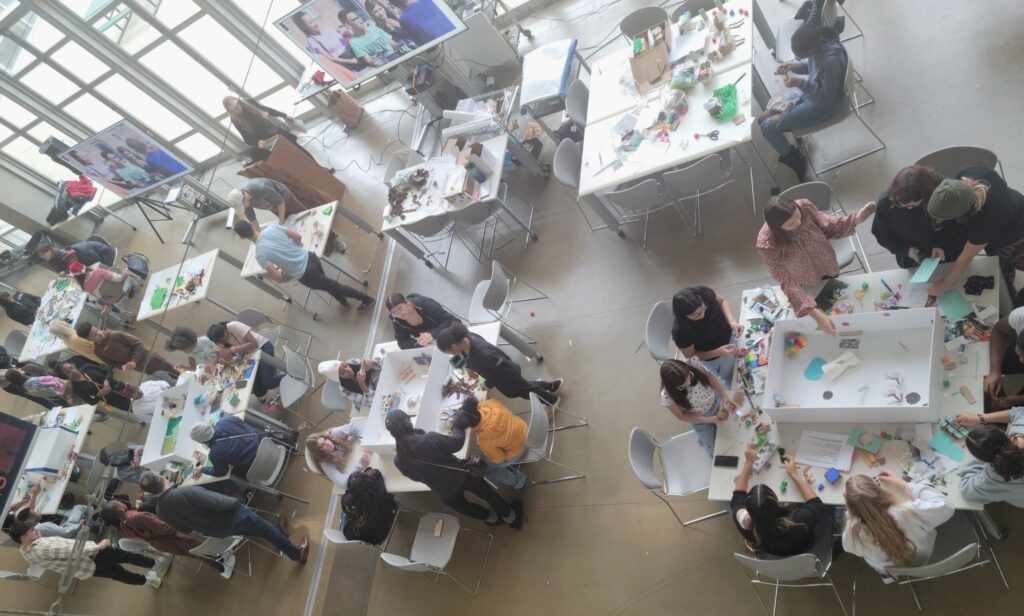
The first effort on this front was the Future Builders Studio, a weekend design camp earlier this month, focused on a new campus for TRUE Skool, in collaboration with Wisco NOMA, leveraging practices and curriculum developed with CDS, and Project Pipeline.
It’s a lot of threads coming together, but its simpler to think of it as aligned efforts operating at three different levels:
- The What: A Future TRUE Skool Campus — TRUE Skool’s new, permanent home
- The How: TRUE Skool Legacy Project — An overarching, youth-engaged effort to envision, design, and realize TRUE Skool’s future and document its story.
- The Who: Future Builders Network — Individuals and organizations ready with expertise, programing, or resources to engage young people in real world projects that prepare them for careers in the building professions.
Our discussion focused on the how and the who.
Discussion
We began the discussion with a brainstorming exercise to identify existing programs and resources that touch some aspect of what TRUE Skool might need to take on between conceptual design and opening a new campus. It’s a long list:
Understanding the ecosystem
Exploration of potential operating models
- Genera8tor
- Lubar School
- Bader Institute for Nonprofit Management
Existing spaces/organizations that could serve as models/inspiration
- Coworking spaces
- Milwaukee Maker Space
- Reflo
- Trust for Public Land
- Discovery World
- Milwaukee Public Museum
- First State
- Black Holocaust Museum
- Juxtaposition Arts (Minneapolis)
- Hip Hop Architecture
- Avis-Elsmere (Detroit)
- Defining Humanity
Data Resources
- City of Milwaukee Property Data
- Data You Can Use
Architecture & design
- UWM Community Design Solutions
- MATC’s Architecture Program
- MIAD
Real estate & local economic development
- Marquette’s Real Estate Program
- Downtown Bid
- ACREs program
- Northwest Side CDC
- LISC
- CARW
- WCREW
- NAIOP
- Mandel Group
Construction
- ACE Mentorship
- AGC
Resources in higher education
- UWM Center for Student Experience & Talent
- Experiential Learning
- Service Learning
- Marquette Trinity Fellows
Youth Engagement
- City on the Hill
- Milwaukee Youth Council
- Journey House
- Boys & Girls Clubs
Mentoring
- HPGM
- Mentor Milwaukee
Potential Funders
- Northwestern Mutual
- Zilber
- Bader
- Baird
- Milwaukee Tool
- Potawatomi
- Generac
- Alliant Energy
- We Energies
- Harley Davidson Foundation
Key Opportunities
From here we moved on to explore the roles partners might play and areas that will be key to advancing the project. As each discussion group shared their thoughts, three things stood out:
- In order to engage students from conceptual design through construction, TRUE Skool needs a plausible model for how a new campus would be funded.
- Regardless of the funding model, TRUE Skool would benefit from greater visibility of both its offerings and approach.
- There are other organizations and facilities within and beyond Milwaukee that could inform the design of spaces within a new campus, potential synergies with other partners who might share space or facilities with True Skool, and/or potential funding models to support development of a new campus.
Operating Model
While TRUE Skool has a strong vision for what they would like a new campus to offer and represent within the community, pulling together funding to lease, acquire and build out that space will require a plausible operating model for that new space. It is the understanding that the project could come to fruition that allows students to see that they are working on something real. It also provides a greater incentive for those who could support or engage students in aspects of this effort– it allows the work they might do with young people to be cast as supporting something much bigger.
Visibility
TRUE Skool and its students have been doing some really interesting work in Milwaukee over the past 10 years. Yet even among the people who came for the discussion, many were unfamiliar with everything TRUE Skool has been involved with and how they approach working with young people. TRUE Skool’s desire to get out of the lower level of The Avenue and into a more visible location is, in part, a recognition of this. A key point of discussion was how TRUE Skool might leverage work on the legacy project as a way to increase visibility of their work:
- Social media takeover
- Popup design workshops or other programs
- Leveraging work with project partners to build exposure through their networks
- Brining programming into schools
- Prototyping ideas within existing spaces — schools, partner organizations, vacant storefronts
Models
Participants called out a number of spaces and organizations within and beyond Milwaukee that might serve as models for what a new campus might offer, how the spaces within it might be designed, or how TRUE Skool might pull together funding for the project. Exploring those models and understanding what aspects of those could be useful for TRUE Skool offers yet another opportunity to engage students in the effort, and connect those students to more points within their community as well as to folks doing interesting work beyond it.
Next Steps
TRUE Skool will be reaching out to Collab Lab participants and other organizations to further explore how to advance the project. Our spring Collab Labs will be the focus of ad Education Policy course at UWM on Community Engagement. As the major assignment of that course, students will plan, produce, and run our May Collab Lab, which will dig a bit deeper into how and where partners and schools can come together to further advance the TRUE Skool Legacy Project.
Thanks
A big thanks to Shalina Ali from TRUE Skool, Michael Sykes from WiscoNOMA, and Ross Younger from BUILTECH, and Danya Almoghrabi from UMW’s Community Design Solutions for working with us to pull the session together and facilitate the conversation, and all those who helped pull in friends and colleagues to join the conversation. Thanks also to the MSOE’s STEM Center our host for another season of Collab Labs.
If you want to get more of sense of TRUE Skool, the work they do and their current facility, visit their website, or take a look at the virtual tour TRUE Skool students captured with some help from Ross Younger.
 Fidel and Shalina are Co-Executive Directors, TRUE Skool, a nonprofit organization with a mission to engage, educate and empower youth and families through Transformative Creative Arts & Hip Hop Culture. Growing up in the “Golden Era of Hip Hop” they understand that Hip Hop culture was a positive empowering force in their lives. It introduced them to past and present leaders, educated them on political and social issues through music and art, created new entrepreneurial opportunities and exposed them to different global cultures in ways that school never did.
 Mike is an Architectural Technician at Mead & Hunt’s Green Bay office. He brings to his work a commitment to community empowerment and a passion to introduce underserved youth to career opportunities in architecture and design. In 2023, Mike organized Wisco NOMA’s first
  Danya is a Milwaukee-based designer and educator whose work blends architecture, community engagement, and playful storytelling. Her practice explores intersections of public space while engaging communities through participatory design. Recognized with several student and professional awards, Danya is committed to socially responsive design that celebrates place, identity, and underrepresented voices.
 We’re in our second year of a working with
  On Monday