
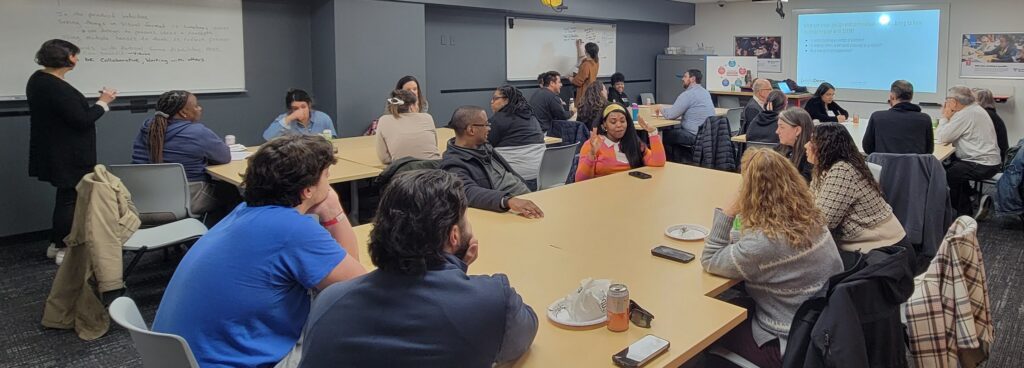
Discussion in our March Collab Lab focused on the role visual design and communication can play in STEM. We started the conversation by asking…
“What can visual design and communication skills bring to how students engage with STEM?”
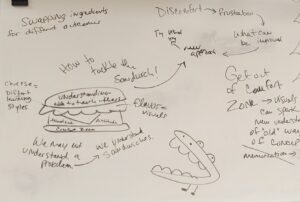 Across our discussion groups, several themes emerged:
Real-World Application: Visual design and communication skills equip students with a new set of tools to explore real-world issues, and at the same time, exploration of real-world issues provide rich opportunities to develop those skills.
Cognitive Scaffolding and Conceptual Clarity: As an alternative to rote memorization, engaging in design and modeling can help making complex ideas more accessible and allow students build a deeper understanding of abstract concepts.
Lowering Barriers to Engagement: Visual design acts as a familiar and low-stakes”entry point or on-ramp that can spark curiosity and personalize the learning experience for students who might otherwise feel intimidated by the subject.
Psychological Safety and Iterative Thinking: The design process fosters a growth mindset by encouraging risk-taking, divergent thinking, and the acceptance of critique, shifting the focus from “finding the one right answer” to process-oriented iteration.
Collaborative Problem-Solving and Agency: Effective communication norms and visual tools empower students to share diverse perspectives, identify real-world problems, and move from frustration toward actionable, solution-oriented thinking.
The Power of Materiality and Tangibility: The specific choice of materials can serve as a physical catalyst that shifts a student’s brain from passive observation to active, sensory-rich experimentation.
Disciplined Observation and Relational Thinking: Visual design trains students to “drill down” on what they are seeing to understand the proximity and relationships between objects, fostering the same observational skills required for scientific inquiry.
Emotional Processing and Personal Agency: By providing a path to move from frustration over a issue toward solutions thinking, design gives students a productive way to process the emotional challenges of difficult STEM problems and claim personal ownership over their work.
From there we move the discussion to…
“Where do we see gaps in developing these skills?”
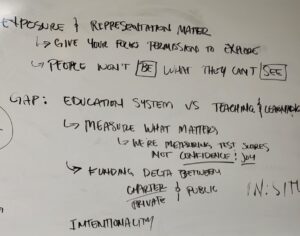 Here too we saw some interesting themes emerge:
The Metric Mismatch: There is a fundamental values gap between what we would like to see (creativity, confidence, joy) and what school systems measure/value: standardized test scores, progress towards credit requirements, and stable schedules.
The “Basics” vs. “Application” Tug-of-War
When visual design/communication in STEM work is an add on at the end of an exploration, rather than a means to explore, the time allocated to this effort becomes secondary to ensuring that students have the basics down. In effect, we ignore the notion that the application of concept is, in itself, an opportunity to understand it more deeply.
Structural Scarcity of Time and Space: Schedules in K-12 don’t support the slower nature of design, iteration, and project-based learning. Without the space and time to get messy, experiment, fail and try again, students are forced to work in a system that asks for the right answer now.
Cultural and Generational Drag:
It’s not just the schools—it’s the surrounding ecosystem. Parent expectations are often rooted in a “how it used to be” mindset, and school leadership may lack the forethought to prioritize interdisciplinary connections over traditional silos.
Equity and Resource Gaps
There is a glaring gap in access. The difference in funding across private, charter and public schools can mean that for many schools, materials and facilities are often a luxury rather than a standard tool for learning.
We ended our discussion with one final question:
What concrete opportunities can you see to develop these skills as part of students’ STEM experiences?
Here are groups took a couple of different paths.
Practices to adopt
- Break out of the box
- Find opportunities to make connections real and concrete in learning
- Experiential learning strategies
- Walk across the hall to connect with colleagues in different disciplines
- Recognize that what you spend time on is a priority
- Work with the rage and frustration within a broken system to bring in some light and joy
Some specific opportunities
- Is there a faculty member in the College of Arts & Architecture at UWM open to having their students work with elementary school math teachers as a service/experiential learning opportunity?
- MIAD already has a program in place to work with K-12 art teachers. What could it look like if MIAD could include STEM teachers in that?
Thanks
A big thanks to the MSOE STEM Center for hosting us, and to all of our featured participants:
Kristin Steinbach Holtz — Experiential Learning Manager, MIAD
Jodi Schomaker — Senior Manager of Creative & Design, Discovery World
Paul Mech – Director of Education, Discovery World
Dr. Aaron Robert Atencio — Research Curator Cultural Sciences, Milwaukee Public Museum
 Aaron is an anthropologist studying cultural continuity and change through image-making across time. His research moves between contemporary photography and the historical and prehistoric production of images—rock art, icons, and iconoclasm—to examine how belief systems can take visual form.
 Kristin has a background in education as a social studies teacher after graduating with a MA in Social Studies Education from NYU. While teaching, she participated in the “Enduring Themes in American History” (ETAH) program, which was a three-year professional development program for high school history teachers, established around 2003 through a collaboration between Columbia’s Teacher’s College, and the U.S. Department of Education. Involvement with this collaboration was where she gained insights into the potentials of experiential learning. She earned a doctorate in Educational Leadership with a concentration in instructional design from UWM and worked for MPS as a social studies teacher at Bradley Tech High School where her students completed interesting projects with community organizations like Arts@Large and Serve2Unite. She then worked for Employ Milwaukee providing career readiness enrichments for several high schools and acted as a Youth Apprenticeship regional coordinator. She returned to Bradley Tech as the Industry Liaison from 2020-2025. Since July 2025, Kristin has taken on the role of Experiential Learning Manager for Milwaukee Institute of Art and Design.
 Jodi has a background in art and design, having graduated from the Milwaukee Institute of Art & Design(MIAD). She has been with Discovery World since the fall of 2012. In her current role, she oversees all visual aspects of the organization. Her work includes exhibit wayfinding, materials styling, exhibit interactives, functional UX storyboarding, large-scale installations, promotional materials, educational materials, and graphics for digital media production. Outside of her work at Discovery World, she enjoys traditional painting and crafting. Her artwork is characterized by bright colors, bold patterns, and occasionally, a cat or two.
 Paul has been delivering and developing informal education programming for nearly twenty years as a member of Discovery World’s Education Team, in roles from part-time educator to department leader. He loves to find different ways to look at and approach topics and tries never to offer something in the same way as school. He believes that everyone can be STEM-literate.