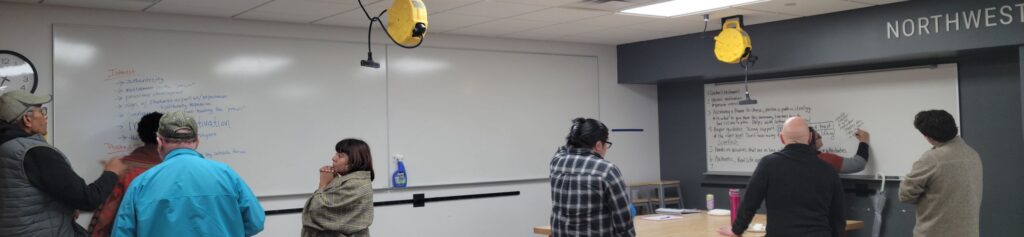
 For our 8th season of Collab Labs, we’re exploring how the lens of the Hero’s Journey can inform how we approach community-engaged project based learning, and what more we can offer students when we do so. Over the course of the 2023-24 season, each of our Collab Labs will focus on a different phase of the Hero’s Journey. We kicked things off last week with Collab Lab 56, a session focused on the call to adventure.
How do we motivate our students to take the first couple of steps on their own learning journey? How do we channel the enthusiasm of some students who clearly identify with a topic and want to set off in pursuit of the prize, bypassing what we as educators believe are essential knowledge and skills in the order we believe these ought to be learned?
What makes a call compelling for students?
We began our discussion with the question, “What makes a call compelling to students?” As attendees explored the conditions for getting students engaged in a big challenge they noted:
- Authenticity of subject, intrinsic motivation
- A teacher’s excitement & confidence
- Proximal development
- Involvement in ‘the process’
- Confidence in the person leading the process >> proper guidance and support, constant work on trust and relationships
- Align with student’s experience and expertise, attitudes and aptitudes (don’t set the student up for failure)
- Culturally responsive and relevant
- The end result will be tangible
- (Appropriate) level of autonomy & power to choose the path that seems most interesting or rewarding
Additionally, much relies on (role modeling) a certain mindset:
- Overcoming competing forces that may hold someone back
- Failure is an opportunity to learn. “A bump in the road is not the road itself”
What has your experience been with creating compelling ‘call to adventure’ for your students?
What do educators and students need to commit to the journey?
With that inventory in place, we moved to a discussion of what needs to be in place for students (and their teachers) to commit to the journey.
On the student side, that includes:
- Trusting relationships, respect, sense of belonging
- Build an iterative experience that gets progressively more challenging
- Create oral/written feedback opportunities that encourage engagement
- Defined roles based on prior experience
- Adjust composition of the learning space to reflect the work
- Normalizing uncertainty
- Being able to see your peers as resources
- Learning how to co-create
- Know and/or find yourself as a learner (EQ)
- Develop understanding of what ‘commit’ means
Barriers for students fully participating in these challenges include:
- Housing instability
- Health issues, Food availability
- May exist outside the school environment >> teacher less aware
- Overall stability inside & outside the learning environment
For educators, the list includes:
- Bring (or gain) personal experience with the journey you’re asking students to take on.
- Professional development on relevant concepts, such as PBL, collaboration, etc., by experts >> those actually doing this work, from a ‘learner first’ perspective >> practical, hands on
- Best practices that are share across schools and districts
- A framework for designing and managing, similar to ‘design thinking’
- Sustainable partnerships to 1) support student projects and 2) share resources
- (how do you) develop community support for a different approach to learning
- (time and energy to) Pursue grants to help support ‘extra’: field experiences, resources, PD, etc.
- Admin support for taking risks with experiments.
If you are a teacher, how are you navigating the hurdles to offering student driven inquiry projects to your students?
In the discussion of barriers for students, several participants brought up a recent piece in the New York Times that noted that economic stability and integration of families, as well as higher levels of teacher pay in the US Defense Department’s schools were among key factors that allow those schools to outperform public school systems. You can find the article here. One caveat noted in the discussion– the focus of these schools is on a standardized curriculum with traditional models of instruction.
A special thanks for our featured guest, Andi Gomoll from Gomoll Research & Design who brought her extensive experience with understanding what motivates and engages users (customers) to the conversation. And, as always, we’re appreciative of MSOE for letting us make use of the NM Lab in the WE Energies STEM Center every month.
Up Next
Collab Lab 57: Dealing with Uncertainty Thursday November 9th, 5:30 to 8:30 pm at MSOE’s STEM Center
Actively using some form of PBL with your students and looking for ideas or encouragement from others? Consider joining your peers in the inspirED Community.

 We’re in our second year of a working with
 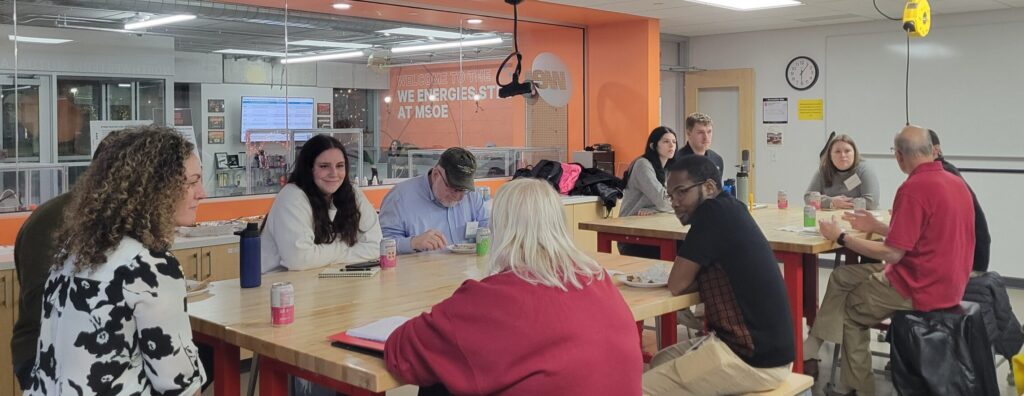 After a break in January, our Collab Lab Series resumed last night with a session focused on dealing with setbacks and recognizing wins.
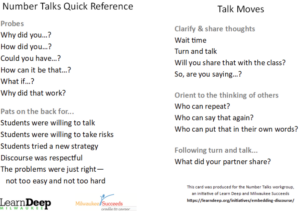 With this inventory in hand, we recounted the story of the Number Talks Quick Refence Card that was developed out of a project we did with K-12 teachers and UWM Math faculty. That project supported teams of teachers who wanted to
  On Monday
 Our experiment Tuesday night: arrange for parents and their children to spend time together in discourse, while attempting to solve math-based puzzles in an after school setting. Since many parents are non-English speaking, we provided UWM student support for translation when needed.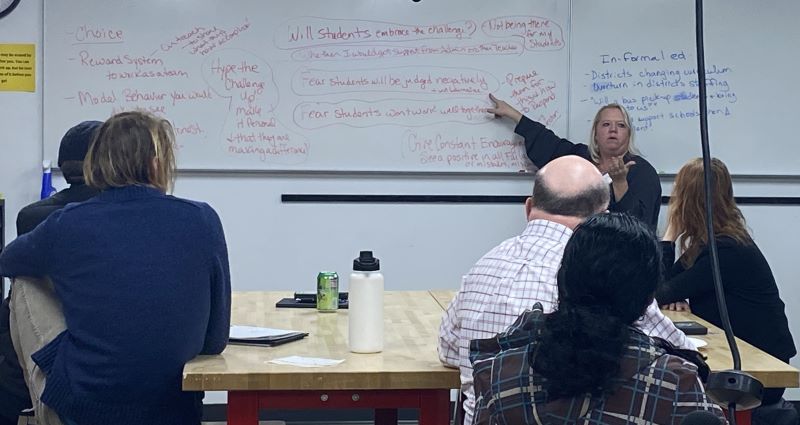
 We’ll be back at